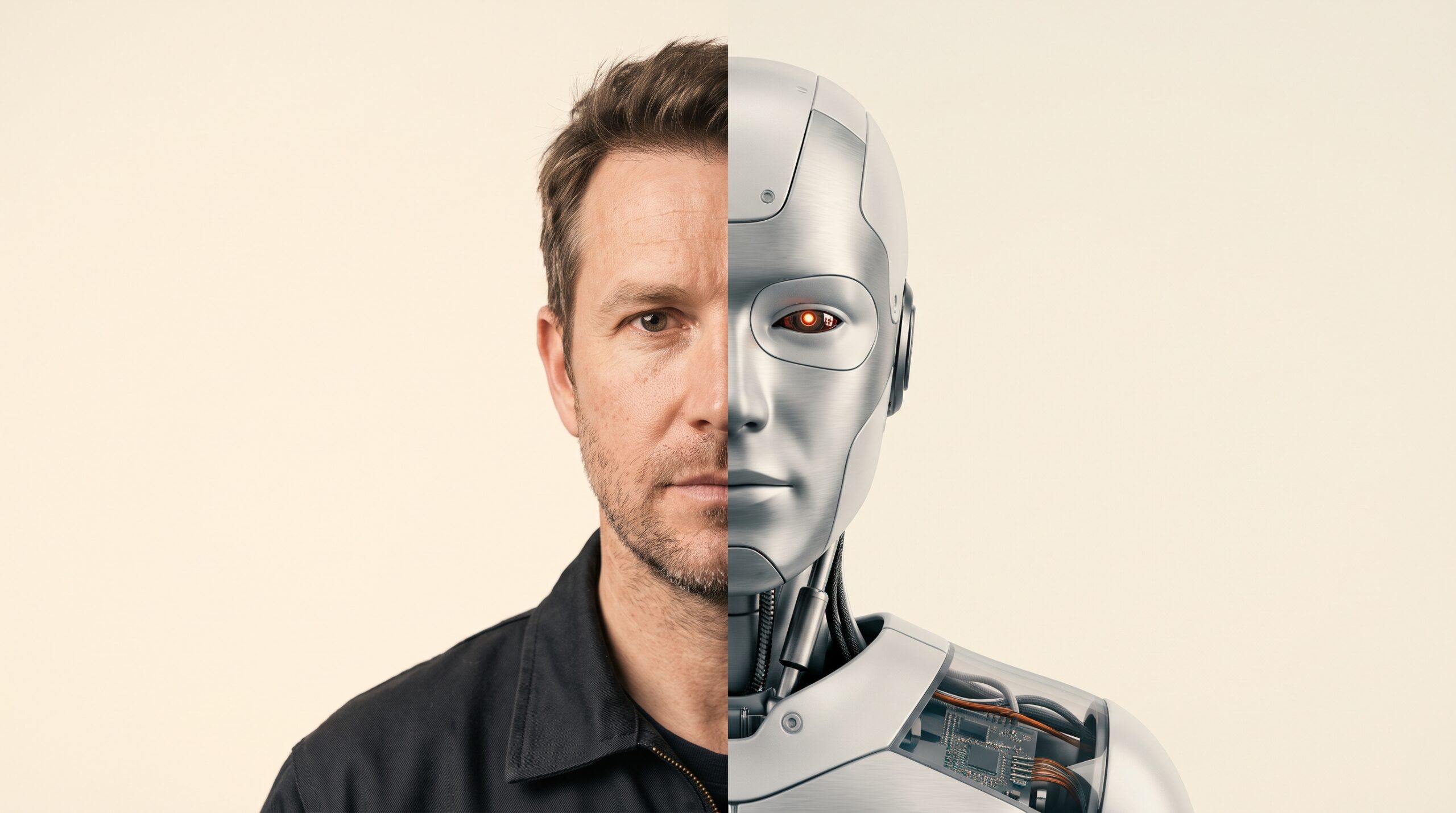

Recently, a heated debate broke out on Danish national television between tech entrepreneur Martin Thorborg and Denmark’s Minister for Culture, Zenia Stampe—sparking a wider discussion around dinner tables and on social media. Maybe you’ve also found yourself wondering whether using ChatGPT for your content actually counts as “cheating.” Here is my take on the matter.
Tempers flared on the Danish current affairs program Debatten when Thorborg and Stampe locked horns over his new autobiography, “Hvad man ikke har i hovedet…” (“What You Don’t Have in Your Head…”)—a book about his own life that he wrote, edited, proofread, and narrated with the help of artificial intelligence.
The Minister for Culture argued, among other points, that the book couldn’t possibly have required much effort and that AI merely “freeloads” on the work of others, to which Thorborg frustratedly shot back: “It’s trained on my fucking material!”
Once the dust settles, we are left with the question I see many people wrestling with: Is AI-generated content just artificial AI slop, or is it genuinely created by a human?
This question is by no means new. It’s a question we can ask of any tool where humans provide the input required for a machine to do the heavy lifting—because if a CNC operator isn’t personally standing there with a hacksaw cutting into a sheet of metal, hasn’t he still cut it?
What is AI-generated content?
AI-generated content is text, images, audio, or video produced using generative AI (artificial intelligence that creates new material based on your instructions). The instruction you feed the AI is what we call a prompt.
The reason the debate continues to rage is likely because people use AI to vastly different degrees—ranging from asking an AI to invent something out of thin air to asking an AI to process your own raw material.
On top of that, there seems to be a lack of technical understanding that AI is a tool requiring human input, guidance, and context. Without that—no output. And the more unique your input is, the more unique the output becomes.
Here are three classic examples where no one judges the result as “artificial”:
- The CNC operator:
The machine mills and cuts the metal sheet with millimeter precision. Yet without the operator’s measurements, drawings, calibration, and understanding of the material, nothing happens at all. - The photographer:
A photographer doesn’t paint every single pixel of the image by hand—the camera’s sensor and mechanics handle that in a split second when the shutter is pressed. But if you just point the camera randomly into the air and press the button, you end up with an unremarkable snapshot. It is the photographer’s groundwork with composition, lighting, angle, and subsequent curation that creates the artwork. - The film director:
A film director doesn’t operate the camera, play the roles, or splice the film strips together—yet it is still the director’s vision, framing, and constant adjustments along the way that create a masterpiece.
The tool simply executes the craft based on the direction set by the human.
When Martin Thorborg feeds an AI hours of his own life stories, mistakes, and experiences from founding major Danish tech companies like Jubii and Dinero, the content still originates from his own head.
You shouldn’t feel ashamed of using AI in your daily life. But you do need to understand that AI is only the camera. You are the one who has to bring it into focus and choose the subject.
When do the critics have a point?
When Zenia Stampe and many consumers balk at AI content, it isn’t coming out of nowhere. Right now, the internet is overflowing with people using AI to skip both the hacksaw and the director’s chair.
I’ve seen several people on social media write things like: “I refuse to read a text written by AI” or “Can you really call yourself an author when AI wrote the book?”
In my view, however, that is an unnuanced way of looking at AI material.
After all, a printer no longer uses a Gutenberg press… yet they are still printers. Conversely, someone who generates a singing voice with AI can’t call themselves a singer—though perhaps they can still call themselves a musician…
It likely depends on the degree of AI usage and what the AI has been used for. For instance, as a singer, you can use AI like Auto-Tune… That way, it’s still your own songs and your own singing voice! …Are you not allowed to call yourself a singer then?
The discussion isn’t black and white, which is why I think we should focus more on whether the content adds value or not… Otherwise, it turns into a meta-discussion where we have to qualify our terminology based on an unknown degree of technology use.
How to create unique content with AI
The title of Martin Thorborg’s book plays on the old Danish proverb “What you don’t have in your head, you must have in your legs” (similar to “work smarter, not harder”). That expression hits the nail on the head when we talk about AI. Major writing projects and advanced marketing—things you might previously have had to write off because you lacked the technical skills—are now within reach. If you have “strong legs” (meaning the willingness to do the groundwork and share your expertise), AI can help with the grunt work, because the most important raw material is still your own experience and personal angle.
Without your own experiences in the engine room, the result becomes the textual equivalent of plastic-wrapped nursing home food—tasteless and completely devoid of soul.
To make your AI material unique and reflective of your tone, you need to add context—and you must continuously enrich and refine that context to get better and better results. This is a process you might casually call “training” or “fine-tuning” your AI. …Even though technicians and developers will point out that it’s merely context and that actual training happens on the language model itself, that distinction doesn’t matter in practice for you. It’s simply about purposefully building upon your foundation so you aren’t starting from scratch with every single task.
Here are four concrete tips on how to add context to your AI:
1. Custom Instructions on your user profile
Chatbots are forgetful and often lose track of who you are across conversations. That’s why Custom Instructions exist (found under settings in ChatGPT, Gemini, and Claude alike). With this feature, you give the AI a permanent profile card about yourself that it automatically reads before every single conversation.
- What should you write in there?
Briefly explain who you are, who your customers or members are, and how you write. - Concrete example:
“I run a local carpentry business in North Jutland. We speak to everyday homeowners at eye level. Always write in short sentences in natural English. Never use exclamation marks, emojis in the middle of sentences, or typical AI clichés like ‘In a world where…’, ‘delve’, ‘tailored’, ‘let’s be honest’, or ‘loving touch’.”
2. Projects in tools like Claude or ChatGPT
When you work on a recurring topic that requires special considerations—and you want the AI to remember them across chats—Projects (in Claude and ChatGPT) come into play. A project works like a digital workspace or binder where you can upload background documents that the AI always consults whenever you write inside that specific project.
- How to use it in practice:
Create a project called, for example, “Marketing for VVS Kompagniet.” Upload a solid batch of the best posts, emails, ads, etc., that you have written yourself. In addition, include a brief description of your core products/services as well as your primary target audiences.
3. Skills
Once your Custom Instructions and Projects are in place, it’s time to focus on the craft of the tasks you repeat over and over. Instead of reinventing the wheel every week, you can build Skills in tools like Claude and Gemini, or Custom GPTs in ChatGPT. A “Skill” is essentially a set recipe for how a specific type of task should be executed from A to Z.
- How it works:
You define once and for all how a great blog post, a great sales post, or a great sponsorship letter is structured at your company (e.g., “Always start with an everyday question, provide 3 concrete tips in bullet points, and wrap up with a casual call to action”).
4. Prompts
Even with the best groundwork in the world using Projects and Skills, AI can’t guess what happened in your business today or what immediate need it needs to solve right now. That is what you use your prompt for. And here, many people make the mistake of staring blankly at the white text box because they think they have to phrase everything neatly from the get-go. Don’t do that. Instead, use your phone’s standard voice recorder or memo app while you’re sitting in the car or walking around the workshop anyway:
- Record a quick voice memo:
Open your phone’s built-in voice recorder (such as Voice Memos on iPhone or Recorder on Android) and record a description of an incident, a customer case, or your off-the-cuff thoughts on a topic. It doesn’t have to be perfect! Don’t start over if you say “um,” pause to think, clear your throat, or stumble over your words and correct yourself along the way. - Attach the audio file to your written prompt:
When you open your AI, simply attach the audio file (or a quick transcript of it) along with a short written prompt. Write something like: “Listen to my attached audio recording. Ignore my ‘ums’ and tangents, and turn my main points into a sharp post for our Facebook page. The angle should be how the customer avoids the mistake I describe.” - Ask for pushback:
Feel free to end your written prompt with the sentence: “Ask me 2–3 clarifying questions before writing the text if any details are missing from my recording.” That way, the AI separates the gold from your “ums” and interviews you like a journalist before writing the final draft.
Q&A on AI-generated content
AI-generated content comes to life through a collaboration where the human sets the direction and the AI acts as the executing tool—just like a camera for a photographer or a CNC machine for a machinist. A language model cannot create anything of value without human input, context, and subsequent curation. The more unique and personal your own brief to the machine is, the more unique and human the final result becomes.
the Danish public television program Debatten in late October 2026 centered on the role of artificial intelligence in culture, media, and the publishing industry, sparked by Martin Thorborg’s autobiography “Hvad man ikke har i hovedet…”. While Minister for Culture Zenia Stampe criticized the use of AI for devaluing human labor and freeloading off the work of others, Thorborg defended himself by stating that the AI had solely helped structure and write his own recorded life stories and experiences.
To preserve your personal voice, you should always feed ChatGPT your own raw material rather than asking it to make up the text on its own. Use your phone’s microphone to record your own experiences, opinions, and professional advice in your own words, and then ask the AI only to clean up the text and format it clearly. Always finish by editing the draft yourself so the sentences sound unmistakably like you.
Yes, most customers can quickly sense when a text has been produced on pure autopilot without human groundwork. Unedited AI texts often rely on the same worn-out sales clichés, impersonal phrasing, and excessive exclamation marks, causing the reader to lose interest. Conversely, when you build the text on concrete details and stories from your own everyday life, the content comes across as authentic and relevant—regardless of whether an AI helped place the commas.