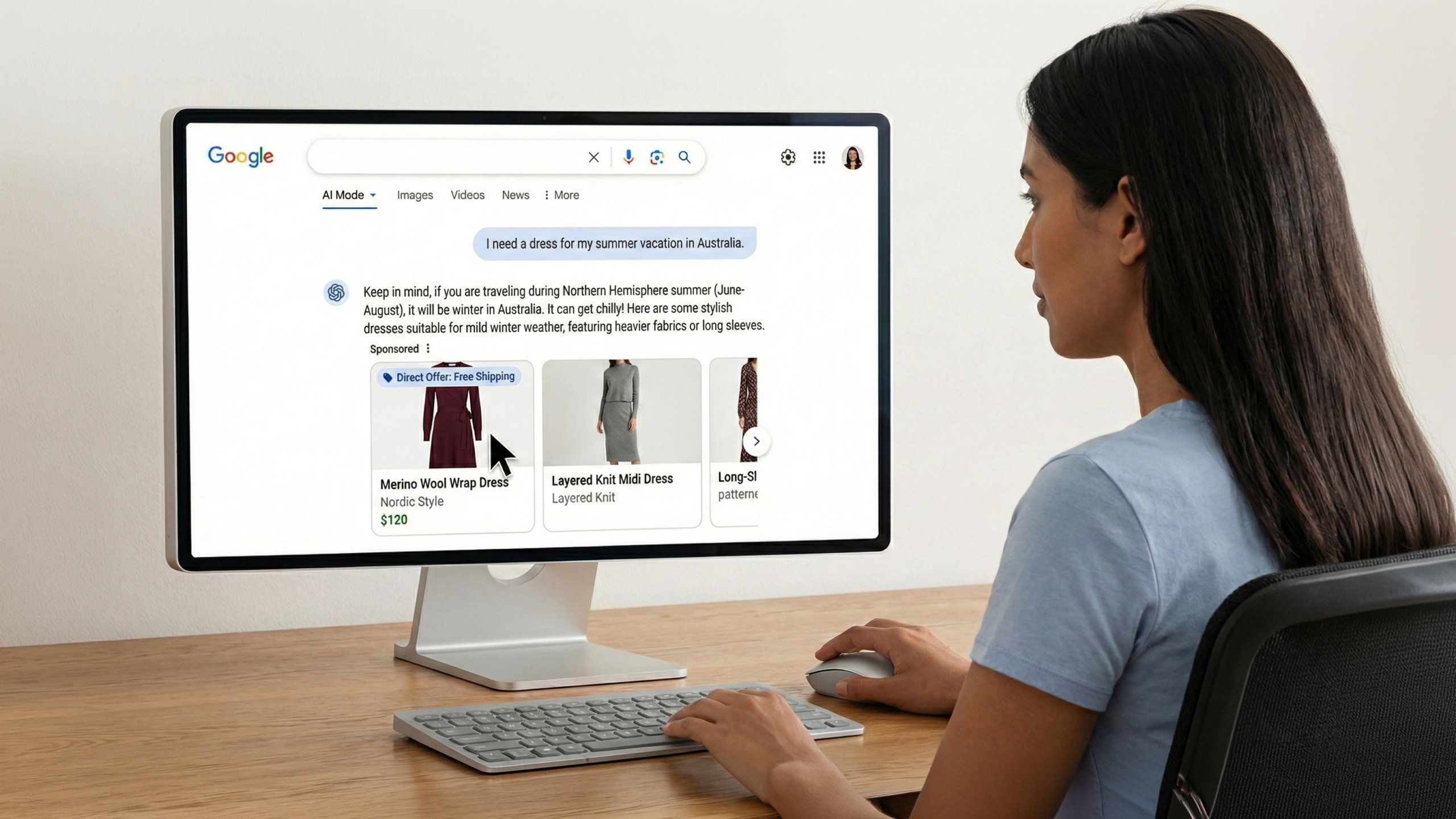

On February 9th, OpenAI revealed that they are testing ads in ChatGPT. Yesterday, Google followed suit and unveiled a similar ad format that lets your store appear right in the middle of the customer’s conversation with the AI.
Back on January 23rd, I wrote here on the blog about how Google’s announcement of the “Universal Commerce Protocol” allows AI to complete purchases on webshops. I warned that trading platforms risk being reduced to mere logistics providers while Google takes over the customer relationship.
Yesterday, February 11, 2026, Google gave us the answer to how we, as advertisers, fit into that picture.
Google is currently testing a new Shopping ad format directly in “AI Mode.”
No more static keywords – now you bid on intent and relevance
Google puts it this way: “We aren’t just bringing ads to AI experiences; we are reinventing what an ad is.” – and they are on to something.
In the “old days,” advertisers bid on specific keywords, which in some cases weren’t always relevant because search terms don’t account for the context of a search. But AI chats are based on Large Language Models (LLMs), giving them a deeper understanding of context and needs.
Google is now using this understanding to introduce an ad format that flows naturally into the conversation.
Imagine a customer asks Google:
“I need a dress for a summer vacation in Australia”
Traditionally, a search like this would show ads for light summer dresses if advertisers bid on the keywords “dress for summer vacation.”
But with the new ad format, the AI understands the context:
- It is the user’s summer vacation (assuming the user is in the Northern Hemisphere).
- The trip is to Australia.
- June and July are winter months in Australia.
Therefore, the AI knows the need is not a light beach dress, but perhaps something suitable for mild winter weather.
When Google spices this process up with their insight into your search history, they might already know your style, brand preferences, and values. And thanks to the Universal Commerce Protocol, you can complete the purchase simply by clicking on the ad, as Google already knows your address and card details from Google Pay.
We are talking about an ad format where you bid on intent and relevance rather than static keywords.
“Direct Offers”: Your new secret weapon
The new ad format is introduced as “Direct Offers.” This gives you the opportunity to show a tailored offer to the customer exactly when they are ready to buy.
This isn’t a discount you need to plaster all over your webshop. It is a “here-and-now” offer for the customer sitting in the AI chat who just needs that final nudge.
This will inevitably result in:
- Higher Conversion Rate (the percentage of ad views that result in a purchase).
- Lower CAC (Customer Acquisition Cost).
Many have feared that when people start using AI to shop, only the very biggest brands will be shown. But context awareness in AI changes the game completely.
It democratizes access to the AI customer by rewarding those who are specialists in their products and can describe them comprehensively. If you run a small specialty shop or offer specialized services, this gives you great opportunities to buy ads in those decisive moments when the customer is comparing options.
How to get ready for the new ads
However, your success with this ad format depends on a combination of your specialist knowledge and the technical setup of your website. Here is what you need to focus on so you don’t get left behind on the platform:
- Comprehensive Product Data in Merchant Center
For the AI to show your ad in a conversation at all, it needs to know everything about your product. It pulls this information from the Google Merchant Center. If you don’t have your titles, prices, stock status, and images in order there, you can’t play the game. - Images and Video are your sales pitch
In the new format, the user must be able to “compare brands” visually. A grainy image won’t cut it. Google is making new tools available (like the image generator “Nano Banana” and video generator “Veo”) to create stunning videos and images automatically. Use them! This is your chance to look just as professional as the big players. - Describe your products and value propositions in prose
Your product descriptions must describe the unique value the item provides to the customer in a specific situation. Don’t think about using specific keywords – instead, describe the concrete benefits and outcomes of your product in natural language.
Q&A on Google’s AI Ads
This is a new type of ad displayed when users chat with Google (Gemini) to find products. Instead of a list of links, the ad shows products from different stores so the user can easily compare them directly within the conversation.
A feature that allows advertisers to show a specific offer (e.g., a discount or benefit) to a user who is close to buying. It appears only in that specific situation and does not change the price for everyone else on your website.
No. Although Google mentions large partners, the system is built on Google Ads and Merchant Center, which anyone can use. It allows small businesses to be seen side-by-side with the big ones if their data and offers are good enough.
Google is currently testing it (February 2026) in the US. But historically, it doesn’t take long for successful formats to roll out globally. Now is the time to prepare your data.