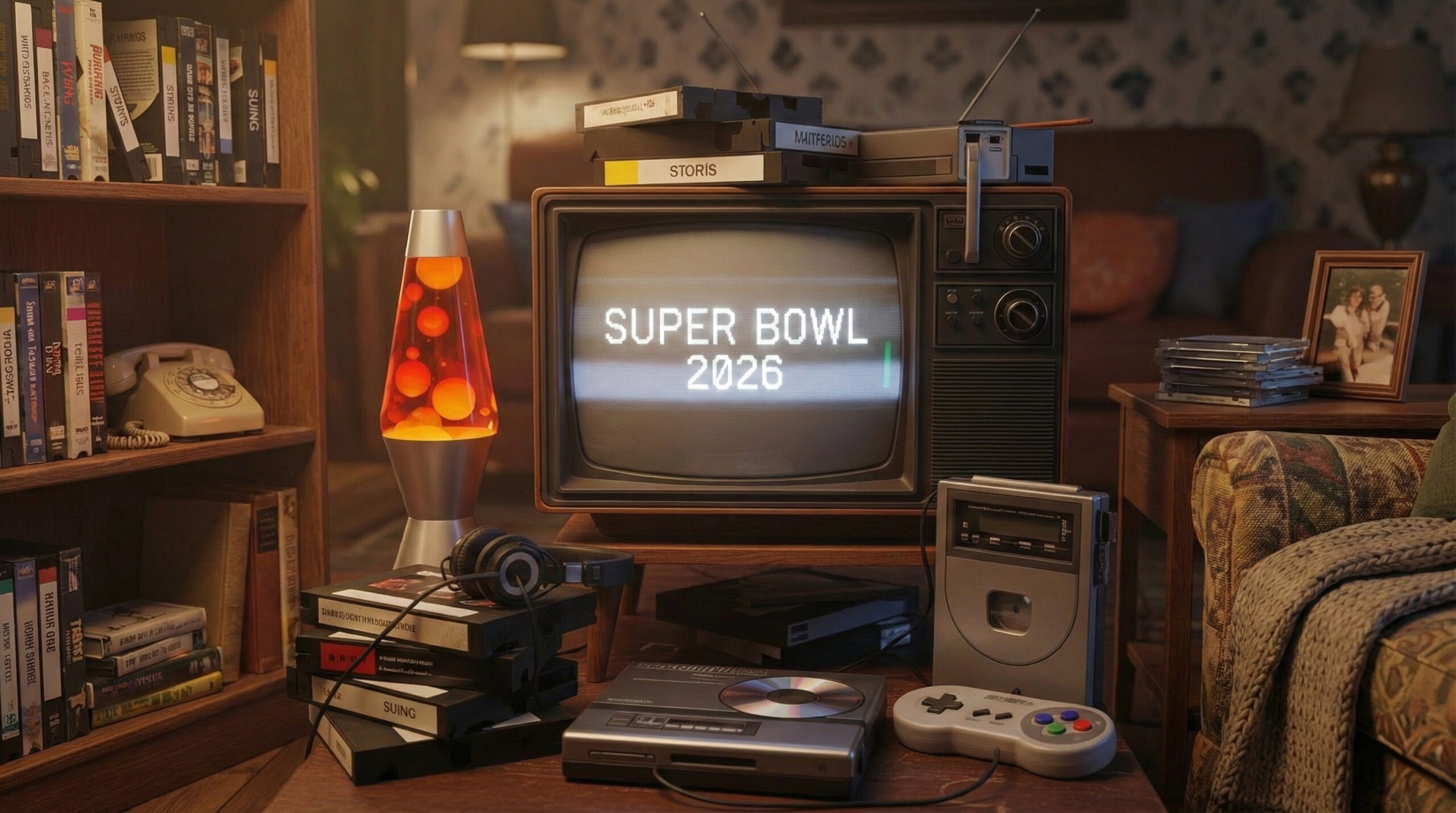

Have you ever heard a song on the radio and suddenly felt a tug in your stomach because it reminded you of your first high school party? Or spotted a vintage car that sent you straight back to the backseat of your parents’ station wagon on the way to a summer cottage?
This phenomenon is called nostalgia, and at this year’s Super Bowl, it wasn’t just a side effect – it was the core strategy.
Often, we see companies struggling to find “the next big thing.” But the truth is, we often reach our customers best by looking backward. This year, the world’s biggest brands have spent billions to make us feel like children and teenagers again.
Why is nostalgia so hot right now?
We live in a time of rapid change, AI, and a sometimes unpredictable world. When things move fast, we seek out the safe and the familiar. For “Millennials” (those born between 1981 and 1996), the pop culture of their childhood serves as a “safe space.”
Nostalgia creates an instant positive association. If I can make you smile over a memory, the chance of you liking my product is much higher.
The 9 Most Nostalgic Super Bowl Ads (And What They Get Right)
Below, I have gathered this year’s most eye-catching examples. Notice how each of them “borrows feathers” from the past to make their message more palatable.
1. Dunkin’ Donuts: “Good Will Dunkin”
This is a pure nostalgia tour de force. With a title directly referencing Good Will Hunting, we are taken into a Dunkin’ shop filled with 90s icons.
- The Nostalgia Factor: See if you can spot references to Friends, The Fresh Prince of Bel-Air, Cheers, Urkel from Family Matters, and “50 Second Tom” from 50 First Dates.
- The Lesson: By gathering so many memories in one place, the ad becomes something you want to watch multiple times to find all the details.
2. Pepsi: The Polar Bear’s Identity Crisis
Pepsi pulls off a stroke of genius by “stealing” their biggest competitor’s mascot. One of the classic Coca-Cola polar bears takes a blind taste test but chooses a Pepsi.
- The Nostalgia Factor: The polar bear is a symbol of Christmas and security for many generations. Seeing it have an identity crisis to the sound of nostalgic music is both funny and provocative.
- The Lesson: You can tease the “big guys” or established norms in your industry with a wink and a smile.
3. Coinbase: Sing-along with the Backstreet Boys
Coinbase uses a simple karaoke screen where we are invited to sing along to the Backstreet Boys classic “Everybody.” However, the lyrics have been changed to be about crypto.
- The Nostalgia Factor: Every Millennial knows that track. It’s impossible not to hum along.
- The Lesson: Music is the fastest shortcut to recognition. If you have a local “hit” or a song everyone knows, it can create instant attention.
4. Toyota: A Journey Through Generations
The ad starts in characteristic sepia tones, showing a father and son in a first-generation Toyota RAV4. The scene cuts to the present, where the child is now an adult driving his father in the brand-new 2026 model.
- The Nostalgia Factor: It hits the feeling of heritage and the memories we create in our cars.
- The Lesson: Show your company’s history. Do you have customers who have been coming to you for 20 years? Tell their story.
5. Levi’s: Backsides Through Time
Levi’s cuts together a series of scenes of people in jeans, but seasons it with references to everything from Toy Story’s Woody to Bruce Springsteen’s legendary Born in the USA cover.
- The Nostalgia Factor: They remind us that Levi’s has been part of the uniform for all major cultural moments.
- The Lesson: Position your product as a classic that never goes out of style.
6. T-Mobile: “Tell Me Why”
Another Backstreet Boys reference. Here, T-Mobile got the group to create a brand-new version of “I Want It That Way” (Tell me why).
- The Nostalgia Factor: It’s pure boyband magic that speaks directly to the heart of the 90s generation.
- The Lesson: Familiarity creates security. When we hear a voice or melody we know, we listen more closely to the message.
7. Xfinity: A Happy Ending for Jurassic Park
What if the technology in Jurassic Park actually worked? Xfinity shows an alternative ending where a technician plugs in a device and everything runs flawlessly. Scenes like “That’s one big pile of shit” turn into “That’s one big pile of shrimp” at a cozy dinner in the dinosaur park.
- The Nostalgia Factor: We love “what if” scenarios based on movies we grew up with.
- The Lesson: Use humor to solve a problem. Xfinity shows that their product removes chaos.
8. Hellmann’s: Sweet Sandwich Time
Here we meet the musician “Meal Diamond” (a pun on the artist Neil Diamond), singing an alternative version of the classic “Sweet Caroline.”
- The Nostalgia Factor: “Sweet Caroline” is the ultimate sing-along song. By changing the lyrics to be about food, it becomes both silly and memorable.
- The Lesson: It doesn’t have to be so serious. Play with words and give your customers a smile.
9. Instacart: 80s Banana Show
Ben Stiller appears with a giant retro mustache and sings about choosing bananas in a style resembling a mid-80s music video – complete with a grainy film filter and wild costumes.
- The Nostalgia Factor: It hits that slightly tacky but lovable 80s aesthetic perfectly.
- The Lesson: Make your marketing visually unique. By using an “old” look in a modern world, you stand out in the feed.
How can you use this in your business?
Nostalgia isn’t about being old-fashioned. It’s about using the past to build a bridge to the future. When you remind your customers of something they love, that love rubs off on you.
You might not afford to hire the Backstreet Boys or buy the rights to Jurassic Park. But smaller efforts can also work. Here are three practical ways to use nostalgia in your marketing:
1. “Then and Now”
Has your business existed for 10, 20, or 50 years? Share a picture of your first shop, your first company car, or your first logo. Show the evolution. It builds trust and shows you are a stable player in the local area.
2. Revive Local Memories:
Are you a local association or business owner? Share stories or photos from local events that everyone in town remembers. “Do you remember the town festival in 1998?” It creates engagement and dialogue on social media that no modern ad can buy.
3. Use Classic References
You don’t have to copy big movies, but you can use the language or style. A video with a “retro filter” or a headline referring to an old saying can make you stand out from the crowd of polished, modern commercials.
Q&A about Nostalgic Marketing
Because we buy with our emotions and justify with logic. Nostalgia activates the brain’s reward center and lowers our defenses.
No, but they currently have the greatest purchasing power. However, nostalgia works on all generations – you just need to know which memories your specific target audience has in common.
Not at all. Most smartphones have filters that can make your videos look like something from the 80s or 90s, and you probably already have old photos lying in a drawer.